REVITALIZING RITUALS
ARTIST OPEN CALL
What is Revitalizing Rituals?
Revitalizing Rituals is an artistic inquiry into rituals as a technology of belonging with the rest of nature. The project operates in the interstice between inherited knowledge, today’s complex realities, and contemporary artistic practice. It seeks to translate rituals into forms that navigate the fracture between human communities, the land and other living forms. Rather than treating rituals as fixed heritage, Revitalizing Rituals approaches them as living, evolving gesturesshaped through deep observation and relational practice with knowledge-keeping communities. Working across distinct urban and rural landscapes in Tunisia and Hungary, the project seeks to move from a state of dissociation toward a sense of reciprocity and mutual flourishing. Revitalizing Rituals is supported by the Creative Europe programme of the European Union.
About the residency
This residency explores the interstices of uprooting and re-rooting across two landscapes defined by a fractured relationship between human communities and the land: the urban margins of Bhar Lazreg (Tunisia) and the transforming wetlands of Somogy County (Hungary). Historically, rituals were the heartbeat of reciprocity. We ask: can artistic gestures revive or reinvent these rituals to move us from dissociation toward belonging, and therefore protection? We invite an inquiry into the narratives of life that emerge when inherited knowledge and buried memories encounter today’s realities through artistic form.
Two sites, one interstitial landscape
Bhar Lazreg, Tunisia
A neighbourhood shaped by rural exodus. Families from the interior have settled here, bringing fragments of rural memory into a dense urban setting. The "ritual" lives in the almost-lost: in songs, recipes, and seasonal rhythms that persist in the urban fold. How can these be translated into contemporary forms for a generation that has grown up detached from their ancestral land?
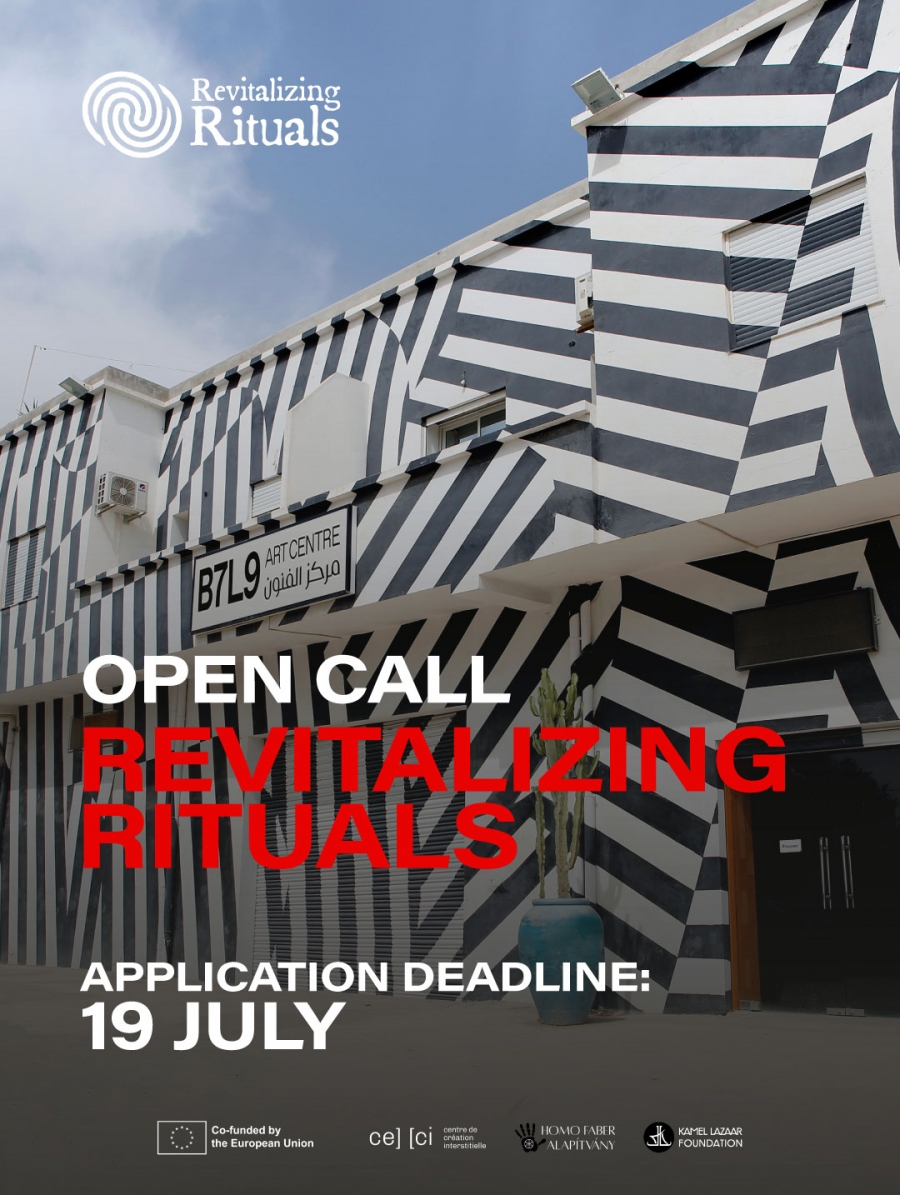
The B7L9, Tunisia's first non-profit contemporary art centre, opened in 2019 in Bhar Lazreg, a lively neighbourhood on the outskirts of Tunis, where locals have been part of B7L9 from the very beginning. It is a space where community has found room to breathe, where dialogue and exchange remain possible away from the pressures of everyday life. The residency places artists in close exchange with locals through workshops, exhibitions, showcases, and performances. What takes shape here is built as much by the neighbourhood as by the artist.
Somogy, Hungary
A landscape of former floodplains where traditional wetland life was erased by regulation. Today, a new community is putting down roots alongside emerging species. Here, the ritual is found in re-learning the land, through foraging, communal gathering, and finding a new balance with a changing ecosystem. Artists will work with the community who live in and around Manas Garden, an 82-hectare permaculture landscape rehabilitation project and festival venue in a beautiful natural setting. The residency invites artists to engage with two primary resonances:- The transmission of embodied knowledge: bridging the gap between those who carry the memory of the land and those for whom it is "almost-lost."- Rituals as living form: reimagining rituals not as fixed traditions, but as artistic forms to negotiate the threshold between past practices and contemporary life.
What we are calling for The residency is designed for artists and creative practitioners interested in working with food, ecology, rituals, storytelling, and relational artistic forms. It is open to all artistic practices, including sound, movement, visual arts, installation, performance and transdisciplinary practices. During the programme, artists will engage with local communities through situated presence, listening, exchange, artistic research, including co-creation.
In total, four artists will be selected: two artists in Hungary and two artists in Tunisia. In each location, one locally connected artist and one artist from a migration or diaspora background linked to the region will take part in the residency. Artists apply individually (or as collectives) and will each develop their own artistic process in dialogue with the local community. While artists in the same location will be able to exchange ideas and learn from one another, they are not expected to create a joint artistic work. We are not looking for social work or environmental solutions; we seek your specific artistic language to explore the movement from extraction to reciprocity, and the transmission of knowledge between generations and species. It is an invitation to use your artistic gesture as a means of inquiry, transformation, and relation within vulnerable and often invisible contexts.
We value:
- Situated presence, deep observation, and seasonal attention.
-Process as matter and relation as an aesthetic space.
- Non-extractive practice, where the gesture emerges from the folds of the collective and is the only way to approach the irrepresentable.
The journey begins with a shared Placemaking camp, for artists and partners to explore relational forms and knowledge. This is followed by a four-month residency process combining onsite work (at least 4 weeks, but can be divided in shorter periods), research, and experimentation. Each previously mentioned location will host two artists working in parallel with the same community context, while developing independent artistic processes and outcomes. We are looking for artists curious about working with situated contexts, where openness, sensitivity, a desire for joyful play, and a commitment to reciprocity are essential. Applicants should have at least three years of practice and be able to communicate in English. We especially encourage applications from artists from migration or diaspora backgrounds connected to the regions.
Although the residencies take place in different local contexts, the programme is built around exchange and dialogue between the communities, artists, and partners in Tunisia and Hungary. The four selected artists will meet during shared camps, online exchanges, and project gatherings, creating opportunities for knowledge-sharing and mutual learning throughout the project.
Artists will also collaborate with visual storytellers who will document the artistic and community processes throughout the residency. One visual storyteller will be selected for Hungary and one for Tunisia through a separate open call. As part of the programme, selected artists will participate in a one-week Storytellers Camp in Tunisia, where artists, storytellers, and project partners will come together to explore documentation methods and develop shared approaches to storytelling. The role of the visual storytellers is not to document final outcomes only, but to capture the relationships, rituals, conversations, and transformations that emerge throughout the residency journey.
What emerges from the Revitalizing Rituals residency? The residency values the process as the primary material for the creation of striking contemporary forms. While we move away from pre-defined outputs, we seek a commitment to artistic potency and precision. We expect each residency process to manifest in artistic gestures that hold a strong aesthetic and conceptual presence - forms that respond to the specific textures of the site and its people. We seek work that is both palpable and poetic, capable of transposing intangible shifts (the building of trust, the surfacing of memory, or new ecological relations) into a visible contemporary artistic language. The goal is to allow for the emergence of a sensible trace: a manifestation that remains irreducible, existing as a sharp and singular expression of the encounter between the artist, the community, and the land.
What we offer
- Artist fee & production budget: 6000 eur gross
- Travel & per diems: covered for international exchanges.
- Accommodation: provided on-site for the duration of the residency.
- Artistic accompaniment: guidance and dialogue throughout the research and creation process.
- Spaciousness: beyond financial support, Revitalizing Rituals offers the luxury of time for slow collaboration and cross-cultural learning within an international network of practitioners and communities.
Applications
Who should apply?
We are looking for individual artists, collectives, and interdisciplinary practitioners. All forms of art are welcome, including sound, movement, visual arts, installation, performance and transdisciplinary practices.
- Practice: An active artistic practice (minimum 5 years) with a portfolio that reflects an interest in situated or relational work. No formal degree is required.
- Language: While the "working" language of the international network is English, we value the ability to navigate the local languages of the communities.
- Availability: Selected artists must commit to the full residency cycle, including international travels (November 2026 Hungary, March 2027 Tunisia, winter/early spring 2028 Hungary), on-site presence (min. 4 weeks), and the ongoing collaborative dialogue.
- Relational ethics: Applicants must demonstrate a commitment to non-extractive practice and a desire for meaningful, reciprocal presence.
- Administrative: Artists must be able to legally receive the fee and invoice the organizing partners in their country of residence.
Revitalizing Rituals is committed to hospitality and durable abundance. We strongly encourage applications from voices that have been historically marginalized or underrepresented. We aim to provide flexible and inclusive conditions that respect the rhythm of the artist and the work.
How to apply
this form Apply by filling out till the 19th of July, 2026.
Evaluation and selection process Applications will be reviewed by the project partners together with the artistic mentors and local community representatives. A small number of shortlisted applicants will be invited to an online conversation before the final selection. Selected artists will be contacted by email.
What are the key deadlines?
The open call is followed by a selection process and online conversations with shortlisted artists. The residency activities begin with the Placemaking Camp and continue through the residency period in Hungary and Tunisia, concluding with public presentations and shared community moments as well as a closing event.
Key Dates https://forms.gle/brnZvXvFe4JB8zL26
Application
Deadline: 19th of July 2026 (midnight)
Open house (Q&A via online platform): 29th of June at 14:00 Tunisia / 15:00 CET.
Please register in order to receive the meeting link.
- Online Conversations with Shortlisted Artists: mid July - mid August 2026
Selection Results: 31st of August 2026
Placemaking Camp: 1 week at the end of November 2026 in Hungary
Storytellers Camp: 1 week in March 2027 in Tunisia
Residency Period: minimum 1 month that can be split into shorter residencies during April 2027 - July 2027
Presentation of the final outcome: August 2027
Closing event in Hungary: 3 days during winter/early spring 2028
Selected artists will receive detailed schedules after the selection process.